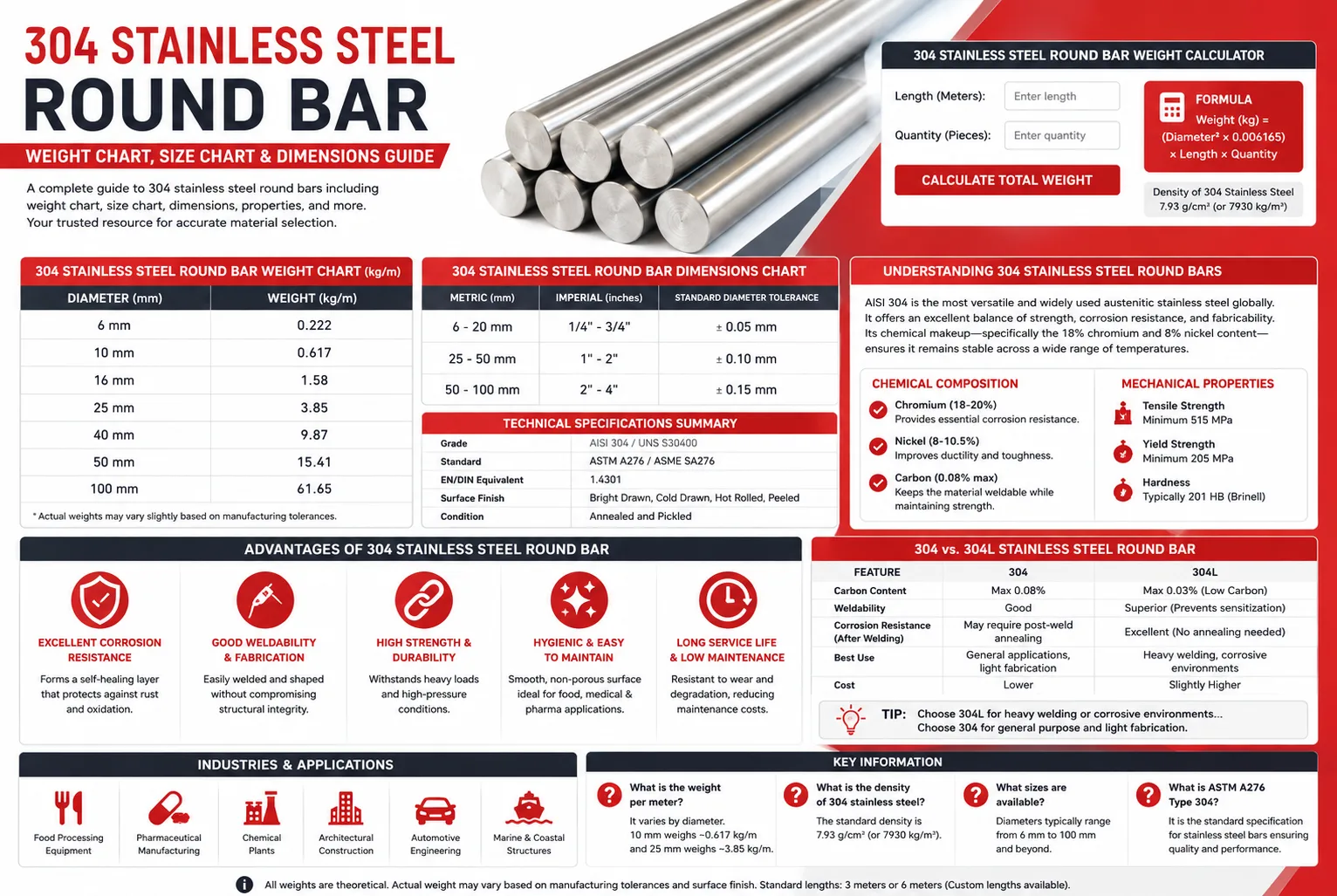
Stainless steel 304 round bars are the backbone of modern industrial engineering. Whether you are fabricating structural components or machining precision parts, understanding the exact weight, dimensions, and material properties is critical for cost estimation and project integrity. This guide provides an exhaustive resource for engineers, buyers, and fabricators to streamline material selection and procurement.
Quick Reference Tools: Weight, Size, and Dimensions
To help you get the data you need immediately, refer to the following tools and charts. These represent the most common requirements for procurement and design planning.
304 Stainless Steel Round Bar Weight Calculator
Use the following parameters to calculate your material requirements:
304 Stainless Steel Round Bar Weight Calculator
304 Stainless Steel Round Bar Weight Chart (kg/m)
The following table provides the theoretical weight per meter for standard diameters. Note that actual weights may vary slightly based on specific manufacturing tolerances.
| Diameter (mm) | Weight (kg/m) |
|---|---|
| 6 mm | 0.222 |
| 10 mm | 0.617 |
| 16 mm | 1.58 |
| 25 mm | 3.85 |
| 40 mm | 9.87 |
| 50 mm | 15.41 |
| 100 mm | 61.65 |
304 Stainless Steel Round Bar Dimensions Chart
When planning your design, ensure your selected diameter conforms to standard production availability.
| Metric (mm) | Imperial (inches) | Standard Diameter Tolerance |
|---|---|---|
| 6 - 20 mm | 1/4" - 3/4" | ± 0.05 mm |
| 25 - 50 mm | 1" - 2" | ± 0.10 mm |
| 50 - 100 mm | 2" - 4" | ± 0.15 mm |
Understanding 304 Stainless Steel Round Bars
AISI 304 is the most versatile and widely used austenitic stainless steel globally. Often specified under the ASTM A276 Type 304 Stainless Steel Round Bar standard, it offers an excellent balance of strength, corrosion resistance, and fabricability. Its chemical makeup—specifically the 18% chromium and 8% nickel content—ensures it remains stable across a wide range of temperatures.
Technical Specifications Summary
| Feature | Specification |
|---|---|
| Grade | AISI 304 / UNS S30400 |
| Standard | ASTM A276 / ASME SA276 |
| EN/DIN Equivalent | 1.4301 |
| Surface Finish | Bright Drawn, Cold Drawn, Hot Rolled, Peeled |
| Condition | Annealed and Pickled |
How to Calculate Weight Accurately
For dimensions not listed in our standard charts, you can use the
industry-standard density of 304 stainless steel, which is 7.93 g/cm³ (or 7930
kg/m³).
The formula used by engineers is:
Weight (kg) = (Diameter² × 0.006165) × Length × Quantity
Common Calculation Pitfalls
Many users forget to account for surface finish tolerances. Cold-drawn bars generally have tighter dimensional tolerances than hot-rolled bars. When calculating for large-scale fabrication, always verify the "as-supplied" tolerance levels to prevent cumulative weight discrepancies in your final bill of materials.
Material Properties and Performance
The performance of 304 stainless steel in the field is dictated by its precise elemental balance.
Chemical Composition
Chromium (18-20%): Provides essential corrosion resistance.
Nickel (8-10.5%): Improves ductility and toughness.
Carbon (0.08% max): Keeps the material weldable while
maintaining strength.
Mechanical Properties
Tensile Strength: Minimum 515 MPa.
Yield Strength: Minimum 205 MPa.
Hardness: Typically 201 HB (Brinell).
These properties make the material ideal for demanding environments, ranging
from food processing equipment where hygiene is paramount, to marine and coastal
structures where chloride resistance is required.
Advantages of 304 Stainless Steel Round Bar
The widespread adoption of 304 stainless steel in critical engineering projects is driven by its unique combination of metallurgical properties, offering reliable performance across diverse environments.
Excellent Corrosion Resistance
Due to its high chromium content, 304 stainless steel forms a self-healing passive oxide layer on its surface. This invisible film protects the metal from oxidation and rust when exposed to moisture and oxygen. It is the gold standard for projects requiring protection against standard atmospheric conditions and mild chemical exposure.
Good Weldability and Fabrication
304 stainless steel exhibits superior ductility, allowing it to be easily cold-worked, formed, or machined into complex shapes without compromising structural integrity. Its excellent weldability makes it the preferred choice for fabricators who use TIG, MIG, or spot welding processes, ensuring strong, reliable joints that hold up under stress.
High Strength and Durability
Designed to withstand significant mechanical loads, these round bars maintain structural stability even under high-pressure conditions. The austenitic structure provides a beneficial balance between yield strength and toughness, ensuring that components remain resilient under both static loads and dynamic operational environments.
Hygienic and Easy to Maintain
The smooth, non-porous surface of 304 stainless steel prevents the accumulation of bacteria and debris. Because it does not require specialized coatings or harsh chemical cleaners, it is widely considered a "hygienic" material, making it the primary choice for sterile environments like medical labs and food processing plants.
Long Service Life with Low Maintenance Costs
Investing in 304 stainless steel often leads to substantial long-term savings. Its inherent resistance to degradation means parts require less frequent replacement and minimal upkeep. Over the lifecycle of an infrastructure project, the initial material cost is significantly offset by reduced labor and maintenance expenses.
304 vs. 304L: Selecting the Right Grade

Selecting the correct grade is essential for ensuring the long-term performance of your components. While 304 and 304L are chemically very similar, their carbon content creates distinct performance differences in industrial applications.
Chemical Composition Comparison
The primary difference lies in the carbon percentage. Standard 304 contains a maximum carbon content of 0.08%, whereas 304L (the "L" stands for Low Carbon) is limited to a maximum of 0.03%. This minor adjustment significantly alters how the metal behaves during high-heat processes.
Mechanical Properties Comparison
In terms of room-temperature mechanical strength, both grades are largely identical, meeting the same minimum requirements for tensile and yield strength. However, 304L offers slightly lower mechanical properties in extreme high-temperature environments compared to standard 304, which is a factor to consider for specialized high-heat engineering designs.
Weldability Comparison
304L is specifically engineered for superior weldability. In standard 304, the higher carbon content can lead to "sensitization"—the precipitation of chromium carbides at grain boundaries during welding—which can make the metal susceptible to intergranular corrosion. By keeping carbon extremely low, 304L prevents this precipitation, ensuring that the weld zone remains as corrosion-resistant as the base metal without the need for post-weld annealing.
Where to Use 304 and 304L Round Bars
Standard 304 is the workhorse of the industry, perfect for structural applications, architectural components, and general manufacturing where heavy welding is not the primary process. 304L is the industry standard for chemical processing equipment, storage tanks, and heavy-duty pipework where the finished component must undergo extensive welding or operate in highly corrosive environments where localized corrosion must be avoided.
Should You Choose 304 or 304L Stainless Steel Round Bar?
Your choice depends on your fabrication process. If your project involves
heavy-section welding or you operate in an environment where corrosion
resistance in the heat-affected zone is critical, choose 304L. If you are
performing light fabrication, machining, or structural assembly where heat input
is minimal, standard 304 is a cost-effective and highly reliable
solution.
For those requiring the enhanced weldability of the low-carbon variant, you can
view our full range of 304L Stainless Steel
Round Bar here.
Frequently Asked Questions
What is the weight per meter of a 304 stainless steel round
bar?
The weight varies depending on the diameter. For example, a 10 mm bar weighs
approximately 0.617 kg/m, while a 25 mm bar weighs about 3.85 kg/m. You can find
precise values for all standard sizes in our weight chart above.
How do I calculate the weight of a 304 round
bar?
You can use our interactive calculator provided in this guide. Alternatively,
use the formula: (Diameter² × 0.006165) × Length × Quantity. This calculation
assumes a standard density of 7.93 g/cm³.
What is the density of 304 stainless steel?
The standard density of 304 stainless steel is 7.93 g/cm³ (or 7930 kg/m³). This
value is the constant used for all accurate weight estimations in engineering
and fabrication.
What sizes are available in SS 304 round bars?
We stock a comprehensive range of diameters, typically starting from 6 mm up to
100 mm and beyond. Please check our dimension chart or contact our sales team
for specific requirements regarding "off-size" or custom diameters.
What is ASTM A276 Type 304?
ASTM A276 is the standard specification for stainless steel bars and shapes. It
ensures that the material meets specific chemical composition, mechanical
property, and quality control standards required for industrial applications.
Is 304 stainless steel suitable for outdoor
use?
Yes, 304 stainless steel is highly resistant to atmospheric corrosion and is an
excellent choice for outdoor structural components. However, for harsh,
high-salinity coastal environments, 316 grade is often recommended to prevent
pitting.
What is the difference between 304 and 304L round
bars?
The primary difference is the carbon content. 304L is a "low carbon" version
(max 0.03%) which prevents intergranular corrosion during welding. Standard 304
has a slightly higher carbon limit (max 0.08%).
Which industries use 304 stainless steel round
bars?
This material is essential in food processing, pharmaceutical manufacturing,
chemical plants, architectural construction, automotive engineering, and marine
environments due to its hygiene, strength, and corrosion resistance.
How accurate is a round bar weight calculator?
A calculator provides a theoretical weight based on standard dimensions. Actual
weight can vary slightly due to manufacturing tolerances in diameter and the
specific surface finish of the bar.
What are the standard lengths available for 304 round
bars?
Standard stock lengths are typically 3 meters or 6 meters. We also offer
professional cutting services to provide exact lengths tailored to your project
requirements.
Final Thoughts
Choosing the right stainless steel round bar is essential for project accuracy and cost-efficiency. Utilize our interactive weight calculator and size charts to streamline your material procurement process. Whether you need standard 304 for general structural use or 304L for specialized welding, our expert team is ready to assist with your specific requirements.