The Foundation of Quality: Understanding Steel Specifications
In the industrial manufacturing sector, precision begins with adherence to global standards. Understanding the difference between a "grade" and a "specification" is critical for procurement managers and engineers aiming to maintain supply chain integrity.
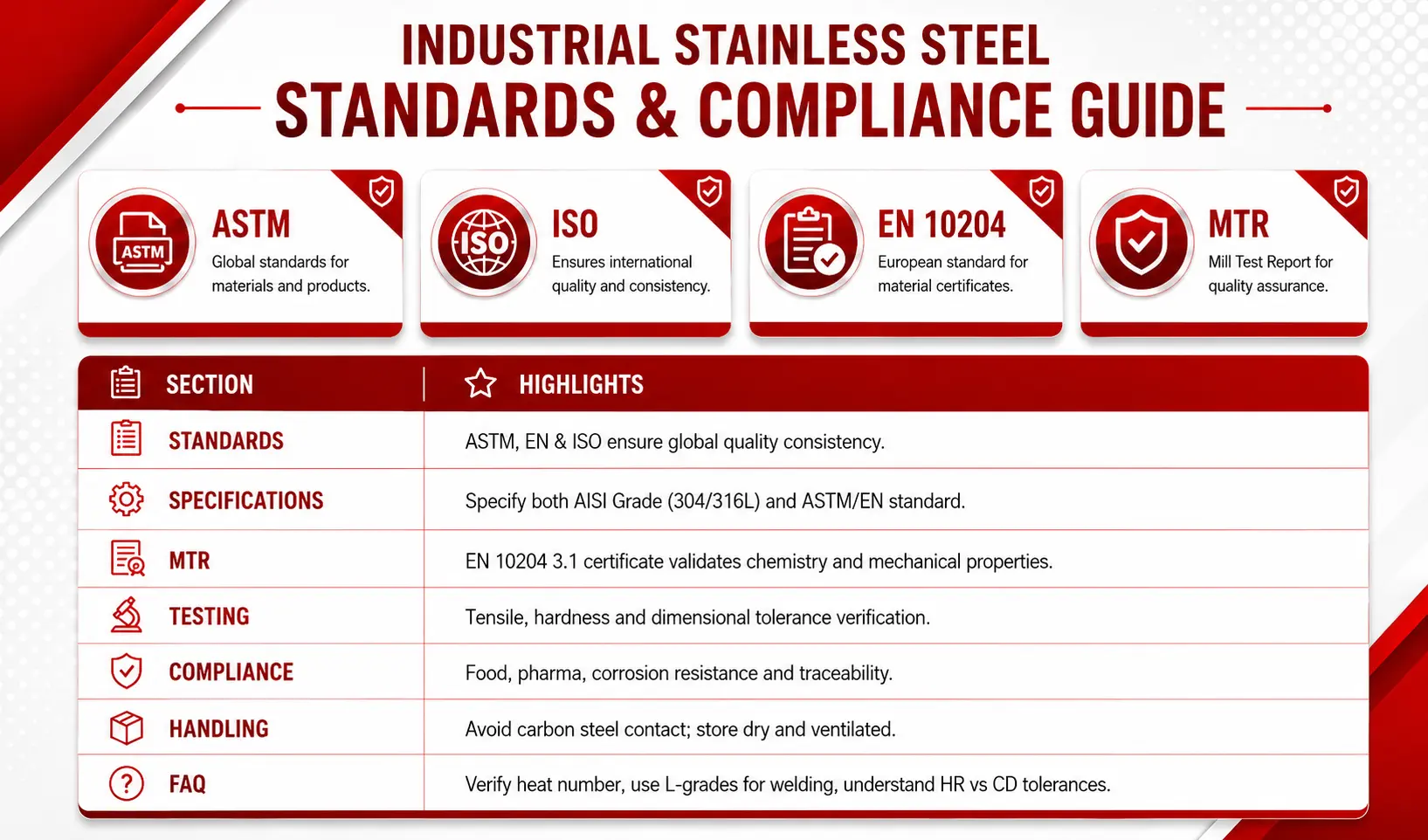
Why standards (ASTM, EN, ISO) matter in procurement
International benchmarks like ASTM (American Society for Testing and Materials) and ISO (International Organization for Standardization) serve as a common language. They ensure that a 304 stainless steel bar sourced in India meets the same chemical and physical criteria as one sourced in Europe. Adhering to these standards minimizes the risk of material failure under stress.
Distinguishing between AISI grades vs. standard specifications
It is vital to recognize that "304" or "316L" refers to the chemical classification (AISI grade). However, the specification—such as ASTM A276 or EN 10088—defines the mandatory testing, inspection, and documentation requirements. Always specify both when ordering your Stainless Steel Square Bar to ensure full compliance.
The role of the Mill Test Report (MTR/MTC)
The MTR (or MTC) is the definitive proof of material quality. Specifically, an EN 10204/3.1 certificate validates the chemistry, tensile strength, and hardness of your batch. Without this, your procurement audit trail is incomplete.
Chemical Composition and Mechanical Property Benchmarks
Grade-specific chemical requirements (304 vs 316L)
The performance differences between Grade 304 and Grade 316L lie in their specific nickel, chromium, and molybdenum content. These chemical differences are governed strictly by specification, which our quality control team verifies against every incoming melt.
Standard mechanical testing methods
To ensure structural safety, every batch undergoes standardized testing, including tensile testing (to measure yield and ultimate strength) and hardness testing (Rockwell/Brinell). These tests ensure the material will perform as expected in demanding industrial applications.
Dimensional accuracy and tolerance standards
Whether you require standard HRAP or precision-cold-drawn finishes, dimensions are controlled by standards like ASTM A484. These ensure that your material is fit for its intended use, whether for machining or structural assembly. See our Weight Chart Guide for how these tolerances impact your material mass.
Compliance in Regulated Industries
Food and pharmaceutical grade standards
In sanitary environments, material purity is paramount. This includes strict limitations on heavy metals and ensuring that surface finishes prevent bacterial accumulation. All material provided for these industries must meet strict regulatory hygiene certifications.
Corrosion resistance and chloride exposure compliance
Environmental variables dictate grade selection. Choosing the right alloy is essential for avoiding premature corrosion. We assist engineers in mapping environmental exposure—such as saline or high-acid industrial atmospheres—to the correct alloy specifications.
Material traceability: From melt to final delivery
Traceability is the hallmark of a high-level supplier. Through heat numbers, every bar can be traced back to its original melt, ensuring that your procurement department has an immutable record of the material's origin.
Handling, Storage, and Post-Delivery Integrity
Maintaining material integrity during transport
Contamination is the greatest risk to stainless steel post-manufacture. Strict protocols, such as avoiding contact with carbon steel during transport and utilizing protective wrapping, are standard procedures to maintain the passive layer of the steel.
Proper storage environments
Stainless steel must be stored in dry, well-ventilated areas, away from chloride-rich atmospheres or carbon steel dust, to prevent oxidation and staining.
Frequently Asked Questions on Steel Compliance
How do I verify if my MTR is authentic?
An authentic MTR will correlate exactly with the heat number stamped on the material. It must include the mill's laboratory accreditation and an authorized signature. Always cross-reference these details against your purchase order.
What is the difference between "standard" and "low carbon" (L-grade) for welding compliance?
Low-carbon grades (e.g., 316L) are specifically designed to reduce the risk of carbide precipitation during welding, which helps maintain corrosion resistance in the heat-affected zone.
Why do tolerance bands differ between hot-rolled and cold-drawn bars?
Hot-rolled bars are processed at high temperatures and typically have wider tolerance bands due to thermal contraction. Cold-drawn bars are processed at ambient temperatures and subjected to cold-work, resulting in significantly tighter dimensional control.