Stainless Steel 304 vs 304L Hex Bars: The Ultimate Indian Sourcing & Sourcing Checklist
Choosing the right grade of stainless steel can make or break the profitability of a high-volume manufacturing run. For engineering workshops and procurement managers across India, the choice frequently comes down to standard Grade 304 versus its low-carbon variant, Grade 304L. Both materials dominate the industrial landscape because of their versatility and excellent mechanical properties.
Selecting the wrong variant can lead to unexpected field failures or unnecessary production overheads. Understanding the subtle chemical differences and processing traits between these two alloys ensures your project stays within budget while maintaining high safety standards. This guide breaks down the technical, commercial, and machining realities to help you select the ideal hexagonal profile for your application.
The Geometrical Edge: Why Engineers Choose Hexagonal Bars
In modern machining setups, the geometry of the raw material is just as critical as its metallurgy. Procuring precision cold-drawn hexagonal rods optimizes automatic machining runs by eliminating unnecessary production steps. Our drawing lines produce highly uniform across-flats dimensions and clean 60-degree corner configurations.
By feeding these true-to-geometry profiles directly into automatic 3-jaw chucks, Swiss collets, or high-speed CNC feeders, engineering workshops completely bypass the secondary manufacturing stage. You no longer need to face-mill flats onto a standard round bar to create gripping surfaces or wrench flats. This structural approach slashes cycle times for mass-production runs of hexagonal components like high-torque nuts, specialized bolts, and fluid power valves.
Ultimately, selecting a pre-shaped hexagonal profile directly lowers your mechanical tooling wear and energy consumption per part. Shorter machining cycles mean your workshop can handle larger order volumes without expanding your machinery footprint. It represents a simple geometric shortcut to improving your bottom-line manufacturing efficiency.
The Core Chemistry: What Sets SS 304 and 304L Apart?
To understand why these two identical-looking bars behave differently under a cutting tool or welding torch, we must look at their chemical composition. Grade 304 represents the global benchmark for versatile, non-magnetic austenitic stainless steel. Formally designated under UNS S30400 and Werkstoff Number 1.4301, its native microstructure relies on a strict combination of minimum 18% Chromium and 8% Nickel.
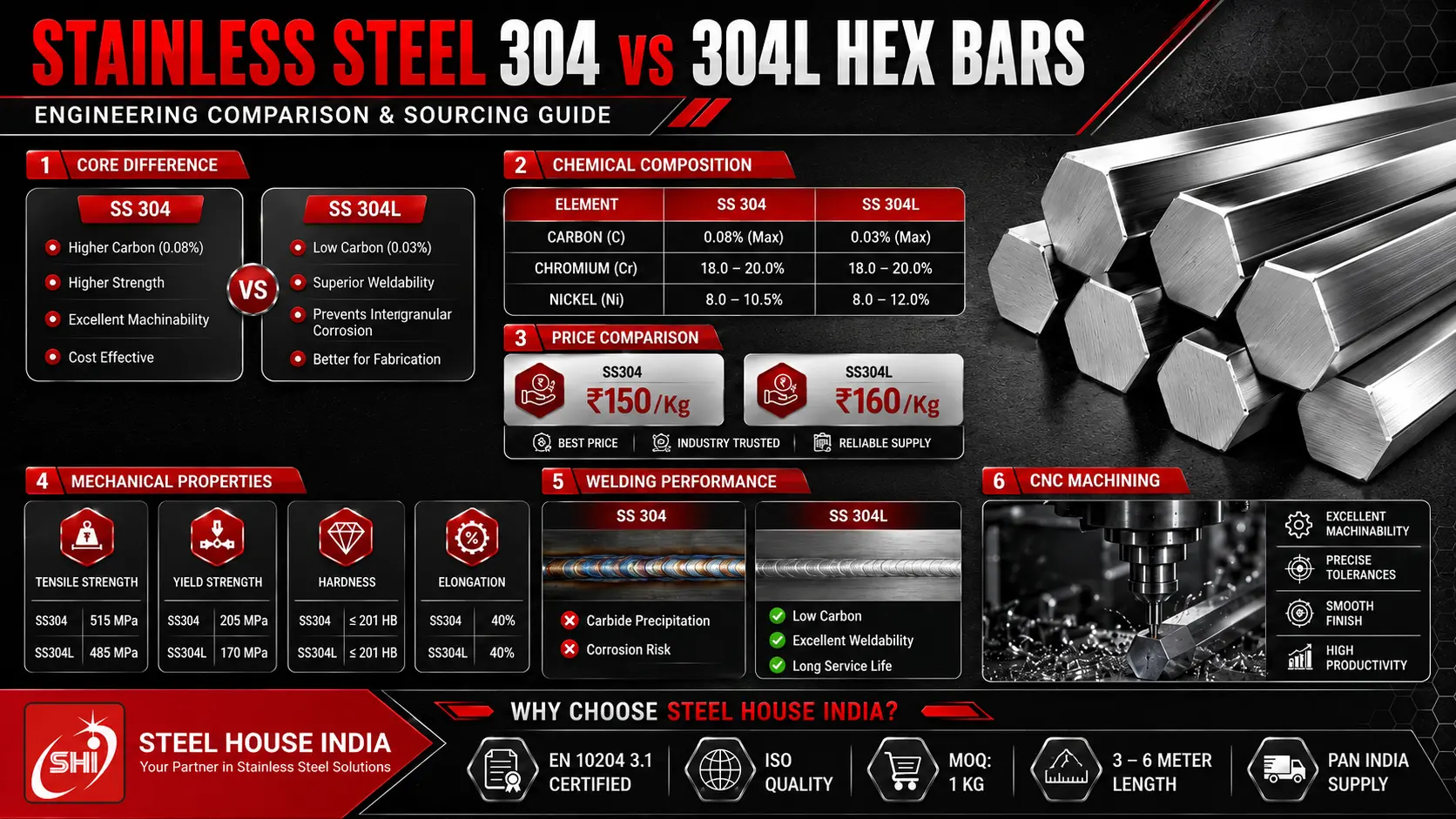
The primary difference between standard SS 304 and SS 304L is that SS 304L contains much less carbon. Standard 304 stainless steel allows a maximum carbon content of up to 0.08%. On the other hand, Grade 304L restricts carbon tightly to a maximum limit of just 0.03%.
The "L" in the name explicitly stands for "Low Carbon." While this slight adjustment might seem microscopic, it completely alters how the metal responds to intense thermal stress, particularly during fusion welding operations.
Core Chemical Composition Breakdown
| Element | Standard Grade 304 | Low-Carbon Grade 304L | Sourcing Purpose |
|---|---|---|---|
| Carbon (C) | 0.08% Maximum | 0.03% Maximum | Controls carbide precipitation during welding |
| Chromium (Cr) | 18.00% – 20.00% | 18.00% – 20.00% | Forms the self-healing passive surface layer |
| Nickel (Ni) | 8.00% – 10.50% | 8.00% – 12.00% | Stabilizes the ductile austenitic structure |
| Manganese (Mn) | 2.00% Maximum | 2.00% Maximum | Improves hot-working strength and hardness |
SS 304 vs 304L Hex Bar Price Comparison: Sourcing Value
When evaluating procurement budgets, understanding the daily raw material baseline is essential for cost management. Currently, the baseline market rate for a standard Stainless Steel 304 Hex Bar starts at approximately Rs 150 per Kilogram (Item Code: 304SSHEX). In contrast, upgrading to a low-carbon chemistry brings the baseline rate for an Stainless Steel 304L Hex Bar to around Rs 160 per Kilogram (Item Code: 304LHEX).
This marginal cost variation of Rs 10/Kg comes down to the specialized metallurgical refining processes required to reduce carbon content below the 0.03% threshold while maintaining microstructural stability. For structural components that will be placed directly into heavy-duty automatic lathe systems for construction and engineering without high-heat welding, the standard 304 grade provides an incredibly reliable, budget-friendly baseline.
If your layout demands extensive fusion welding, investing in the low-carbon 304L variant eliminates the long-term structural risks of intergranular cracking—ultimately saving thousands in secondary post-weld heat treatment costs. As established Stainless Steel 304 Hex Bars Suppliers in India, Steel House India supports both production paths with a highly flexible 1 Kilogram Minimum Order Quantity (MOQ) and standard single-piece lengths from 3 to 6 metres to keep your operational prototyping seamless.
Commercial Sourcing and Reference Rate Matrix
| Material Grade Line | Item Control Code | Baseline Rate (INR / Kg) | Minimum Order Quantity | Preferred Application |
|---|---|---|---|---|
| Stainless Steel 304 | 304SSHEX | Rs 150 | 1 Kilogram | Heavy CNC Machining, High-Torque Fasteners |
| Stainless Steel 304L | 304LHEX | Rs 160 | 1 Kilogram | Heavy Structural Assemblies, Fusion Welding |
The Welding Dilemma: Understanding Intergranular Corrosion
When standard SS 304 is exposed to high temperatures between 425°C and 850°C, it undergoes a damaging metallurgical phenomenon known as chromium carbide precipitation. During welding, the excess carbon within the heat-affected zone (HAZ) binds with the surrounding chromium. This chemical reaction forms dense carbide particles along the grain boundaries of the steel.
When chromium is tied up in these carbide particles, it can no longer form its protective surface layer. This localized drop in chromium levels leaves the area right next to the weld seam highly vulnerable to rusting, pitting, and cracking under environmental stress. This specific type of structural degradation is called intergranular corrosion.
By switching to a low-carbon alloy like SS 304L, you completely bypass this risk. Because there is almost no excess carbon available to bind with the chromium, the alloy eliminates carbide precipitation during cooling. The material keeps its native corrosion resistance completely intact across the entire joint area, ensuring long-term safety in demanding field assemblies without the need for expensive post-weld heat treatments.
Mechanical Strength Trade-offs: Tensile vs. Low Carbon
While lowering the carbon content solves your welding vulnerabilities, it does introduce a slight trade-off regarding physical strength. In austenitic alloys, carbon acts as a natural interstitial strengthening agent. Because standard Grade 304 retains higher carbon levels, it naturally exhibits slightly superior mechanical properties compared to its low-carbon sibling.
Standard 304 bars deliver a higher minimum yield strength and ultimate tensile strength. This makes them highly resilient against heavy torsional loads, high-vibration stress, and mechanical wear. If your components are designed for high-stress applications that require strict structural stiffness but involve zero welding, the standard 304 alloy provides a more robust performance baseline.
Conversely, Grade 304L displays a minor reduction in certified tensile thresholds. In most standard architectural or low-pressure fluid setups, this small drop in yield strength is practically unnoticeable. However, for precision structural calculations or critical high-pressure oil and gas fittings, engineers must account for this strength difference during the initial design phase.
Certified Mechanical Strength Comparison
| Mechanical Property Profile | Standard Grade 304 | Low-Carbon Grade 304L | Engineering Significance |
|---|---|---|---|
| Ultimate Tensile Strength | 75,000 psi (515 MPa) | 70,000 psi (485 MPa) | Maximum load capacity before fracturing |
| Yield Strength (0.2% Offset) | 30,000 psi (205 MPa) | 25,000 psi (170 MPa) | Point of permanent structural deformation |
| Elongation Percentage (in 50mm) | 40% Minimum | 40% Minimum | High ductility and ease of cold forming |
| Brinell Hardness (HB) | 201 Maximum | 201 Maximum | Wear resistance and machinability limit |
Machining Characteristics in Automated CNC Lathes
When running high-speed CNC automated machining lines, tool wear and cycle efficiency dictate your total operational profit. Cold-finished hexagonal bars are highly valued because their close dimensional tolerances reduce machine chatter and vibration. However, the differences in carbon levels between 304 and 304L will subtly impact how your cutting tools perform.
Standard Grade 304 tends to work-harden slightly faster under the cutting edge due to its higher carbon structure. Machinists need to maintain consistent feed rates and sharp tooling geometry to prevent the surface of the bar from glazing over. Proper chip-breaking strategies are required to keep long, stringy austenitic turnings from nesting around the chuck or tool turret.
Grade 304L, being slightly softer due to its lower carbon footprint, cuts with marginally less resistance. This can lead to a slight extension in tool life when running continuous mass-production cycles. However, because it is more ductile, it can occasionally produce a "gummy" machining behavior if your cutting speeds are too low, which can impact the ultimate surface finish if your coolants and speeds aren't fully optimized.
Sourcing Verification: Documenting Quality & MTC Requirements
Sourcing industrial alloys requires a manufacturing partner capable of backing up material claims with certified quality controls, reliable processing capabilities, and efficient logistics. When ordering cold-drawn hexagonal rods for critical applications, simple visual inspections are never enough to guarantee compliance. You must ensure your material provider can supply deep chemical and physical tracking data.
Every order shipped from our Mumbai facility is accompanied by comprehensive EN 10204 3.1 Mill Test Certificates (MTC). This documentation provides complete traceability back to the original VOD/AOD furnace heat numbers. It details the exact chemical composition percentages, mechanical elongation metrics, yield properties, and non-destructive testing results to verify that your bars meet international thresholds.
Whether you purchase a small 1 Kg bundle for prototype validation or close a multi-ton commercial contract, the documentation standards must remain perfectly consistent. This level of traceability ensures that if your quality compliance team runs an internal audit, you can instantly prove the exact carbon threshold of your inventory down to the last decimal place.
Choosing the Right Finish for Your Applications
The surface finish of your hex bar plays a vital role in both its final aesthetic appeal and its structural longevity. For precision engineering applications, cold-drawn or bright-polished finishes are standard. Cold drawing improves the underlying mechanical strength of the bar while delivering tight dimensional tolerances that conform to strict metric reference grids.
A bright polished or centerless ground finish is ideal for visible architectural trim, food processing machinery, or commercial consumer goods. These smooth surfaces make it incredibly difficult for contaminants, bacteria, or moisture to pool in micro-crevices. This maximizes the effectiveness of the alloy's natural chromium oxide passive layer, keeping maintenance costs minimal throughout the product's lifespan.
For heavy-duty structural frames or industrial support layouts where aesthetic perfection is secondary to structural load capacity, a standard hot-rolled or pickled finish may suffice. These finishes offer a highly practical, cost-effective baseline for rugged industrial environments where components will be covered, painted, or integrated into enclosed machinery assemblies.
Strategic Procurement Summary & Conclusion
When selecting materials for automated lathe runs, top-tier Stainless Steel 304 Hex Bars Manufacturers in India provide full EN 10204 3.1 certification to ensure total heat traceability. Sourcing standard 304 bars at Rs 150/Kg from established Stainless Steel 304 Hex Bars Suppliers in India optimizes budgets for high-tensile, non-welded applications like CNC-machined fasteners. However, upgrading to low-carbon 304L hex bars at Rs 160/Kg is essential for components requiring heavy fusion welding to eliminate the risk of intergranular corrosion. Partnering with a reliable supplier like Steel House India guarantees your material arrives completely defect-free, fully certified, and backed by a flexible 1 Kg minimum order quantity.
About The Author