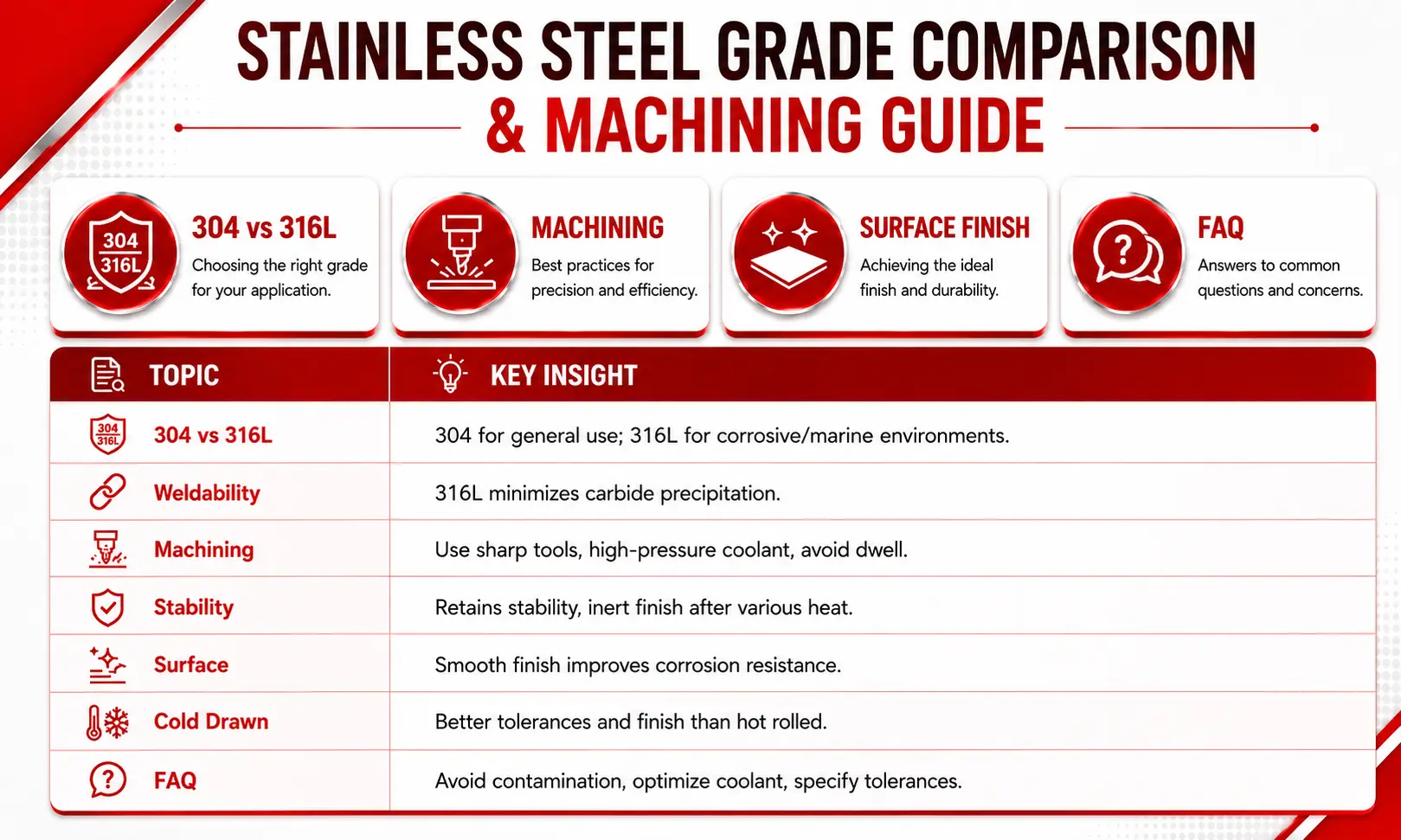
Choosing the Right Alloy: Beyond the Chemical Specs
304 vs. 316L: The "real-world" performance difference
When selecting between stainless steel grades, many engineers focus solely on the composition chart. However, the practical difference lies in application. Grade 304 is the industry standard for general-purpose components, offering excellent formability and welding characteristics. In contrast, Grade 316L contains Molybdenum, which serves as a vital "insurance policy" against pitting and crevice corrosion in aggressive industrial environments or marine atmospheres.
The trade-off between corrosion resistance and weldability
Choosing an "L-grade" (low carbon) variant like Grade 316L is a strategic decision to avoid carbide precipitation. During welding, standard high-carbon grades can lose their corrosion resistance at the heat-affected zone. By specifying Grade 316L, you ensure that your structural components retain their protective passive layer even after intensive fabrication, preventing the "weld decay" that often plagues structural projects.
When to stop over-engineering
While Grade 316L is superior in extreme conditions, it is not always the correct economic choice. For interior structural frames, dry storage components, or non-corrosive manufacturing environments, Grade 304 is perfectly adequate. Choosing the right material for the environment saves your project budget without sacrificing the safety or structural integrity of your build.
Shop Floor Survival: Machining Stainless Steel
Taming the "Work-Hardening" beast
Austenitic stainless steels like Grade 304 and Grade 316L are notorious for work-hardening. This means the material becomes harder the more you cut it. To prevent this, your machine operators must prioritize high-pressure coolant application and ensure the cutting tool never "dwells" or rubs against the workpiece surface. A sharp, positive-rake insert is essential to cut under the work-hardened layer, preventing the common issue of burnishing or premature tool failure.
Coolant and Tooling: The hidden keys to part quality
Generic machining practices often lead to galling—where the steel "picks up" and welds itself to the tool tip. Success with stainless steel requires moving away from standard speeds. We recommend consistent, high-flow coolant to break chips and carry heat away from the cutting zone. If you notice your tool life dropping significantly, it is rarely the grade itself; it is usually an imbalance in the feed-to-speed ratio or a lack of rigidity in the machine setup.
Dimensional stability: Why parts move after machining
Because of the stresses inherent in cold-worked bars, removing a significant amount of material from one side can cause the bar to "bow" or twist. For high-precision parts, we recommend rough-machining to near-net shape, allowing the material to stabilize, and then performing a final light pass. This approach accounts for residual stresses and ensures your tolerances hold true once the part is released from the CNC fixture.
Processing & Surface Integrity
Why the surface finish matters more than you think
Surface roughness (Ra) is not just an aesthetic choice. In industrial applications, a smooth finish is the first line of defense against corrosion; a rough or burred surface creates "micro-pockets" where chlorides or contaminants can collect, leading to localized pitting. Whether you are aiming for a functional machine finish or a polished architectural look, the integrity of the surface is vital for the long-term performance of the alloy.
Cold-drawn vs. hot-rolled: Choosing your starting point
Your choice of initial bar condition dictates the effort required in the machine shop. Hot-rolled bars have a thicker, harder oxide layer (scale) that is abrasive to tools, whereas cold-drawn bars offer tighter dimensional tolerances and a cleaner surface. Starting with a cold-drawn bar—which is the standard for our SS Square Bar Category—significantly reduces your pre-machining preparation time and improves final part accuracy.
Frequently Asked Questions (The "Lessons Learned" Section)
Why did my 316L parts show surface rust after machining?
This is almost always due to "cross-contamination." If your tools or workbench have previously been used for carbon steel, the iron particles transfer to the stainless steel. Once exposed to moisture, these particles rust, making it look like your stainless steel is failing. Use dedicated tooling for stainless work.
Is my tool life falling because of the grade or my coolant mixture?
It is usually the coolant. Austenitic stainless steel requires a coolant with high lubricity. If your mixture is too lean, the tool will overheat, lose its edge, and begin to work-harden the metal, creating a cycle of rapid tool degradation.
What's the one thing I should tell my procurement team before they order my next batch of steel?
Specify the exact finish and tolerance class (such as h10/h11). Providing these details ensures that the material arrives in a state that matches your shop's capabilities, preventing unnecessary extra passes on the machine and keeping your project costs under control.